Thirty Seconds, No Judgment: Turn Your Toy Shelf Into a Gesture-Drawing Bootcamp
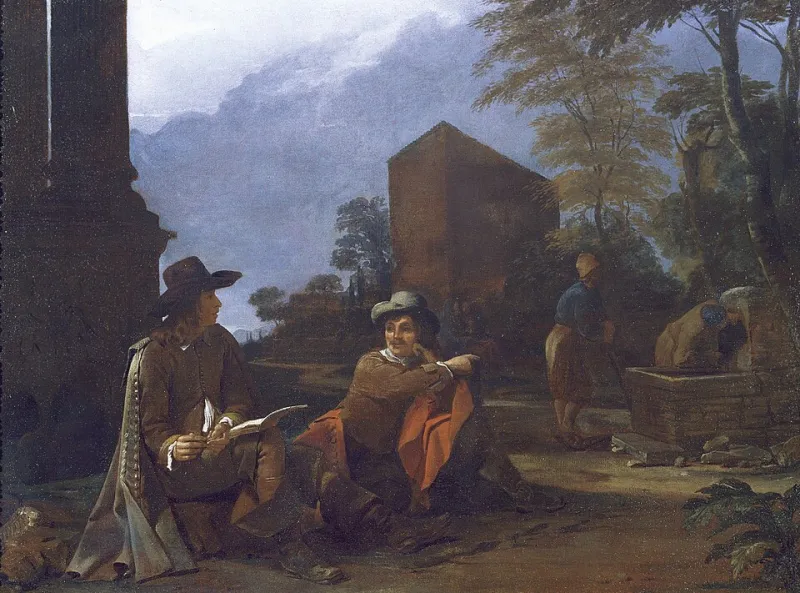
Photo: Michiel Sweerts, Public domain, via Wikimedia Commons
A drop-in life drawing session around here runs $20 to $30, starts at 7 p.m. on a Tuesday, and hands you a living, breathing person who has to hold a pose while your pencil slowly panics. That person is also, understandably, a little self-conscious. So are you. Everyone in the room is quietly worried about being looked at, and that is a terrible condition for making loose marks.
The figure on your shelf has no such hangups. It will hold the same tilt for an hour. It will let you walk around it. It will not check its phone, shift its weight, or ask how much longer. And it will happily return to the exact pose you left it in when you come back next week.
That is not a downgrade. For the specific skill of gesture drawing, it is a genuinely good deal.
Why Plastic Beats a Live Model for This One Skill
Let us be honest about the tradeoffs. An action figure has seams, visible joints, and a stiff shoulder that no human possesses. It has no soft tissue, no rib cage expansion, no weight shifting into a hip. If you want anatomical accuracy, a real model wins.
But gesture drawing is not about anatomy. It is about the line of action, the flow of weight, and the decision you make in the first three seconds before your brain starts editing. For that, you need repetition and zero pressure — two things a plastic figure supplies in unlimited quantity.
It also solves the three things that quietly kill most drawing habits: scheduling, self-consciousness, and the fear of wasting a paid session.
Round One: Five Minutes of Thirty-Second Gestures
Set a timer for thirty seconds. Pose the figure. Draw one continuous, sweeping line that captures the whole angle of the body — head to toe, one stroke, do not lift the pen. When the timer buzzes, re-pose and go again.
Ten poses gets you five minutes of pure decision-making. Use a ballpoint or a soft pencil on cheap newsprint so nothing feels precious. You are not making drawings. You are making marks that could become drawings.
The first three will feel awful. Round eight usually surprises people.
Round Two: Two-Minute Weight Studies
Now slow down just enough to ask one question per pose: where is this thing's center of gravity, and does the drawing show it?
Drop a faint vertical plumb line from the base of the neck. If the character is leaning, the line should land somewhere meaningful — over a planted foot, or deliberately past it. Then check the drawing against the figure. A standing pose should look like it could fall over. A balanced pose should look boring in the right way.
This is the round where you learn to draw the floor, not just the body.
Round Three: The Joint Study
Pick one articulation — elbow, knee, hip — and pose it at three different angles across three quick drawings. On the left side of the page, draw the silhouette exactly as you see it. On the right, sketch the mechanical joint underneath: the pin, the socket, the gap that stops it from rotating further.
This sounds like engineering homework. It is actually the fastest way to notice where human motion differs from plastic motion, which is exactly the kind of gap that makes otherwise-correct drawings look wrong.
Round Four: Extreme Angles and Foreshortening
Most of us draw figures from eye level, over and over, until the skill plateaus. Fix that with the phone camera. Set it on the desk at the height of a low viewer, or look down from standing. Foreshortening shows up immediately — the thigh that disappears into a knee, the arm that becomes a wedge.
Draw what you see, not what you know is there. Two minutes per angle, four angles, and stop.
Round Five: Blind Contour, Then Memory
Sixty seconds of blind contour: eyes on the figure, pencil on the page, no peeking. The result will be a wobbly mess. Keep it anyway.
Then turn the figure around, put it behind you, and draw the pose from memory. Compare the two. The gap between them tells you what you were actually looking at versus what you assumed.
Set Up a Ten-Minute Kit
Keep a shoebox by your desk with a sketchbook, two pens, a lump of sticky tack, and a matte black index card for a backdrop. One desk lamp, angled from the side, gives you shadows that read as form. That is the entire studio.
Travel version: one figure in a jacket pocket, one pen, a napkin. Airport gates are excellent classrooms if you do not mind the stares.
What This Actually Trains
Not perfect anatomy. Speed of decision, sensitivity to weight, and the willingness to make a bad mark and move on. The exercise works because the stakes are absurdly low and the repetitions are absurdly high — the opposite of a $30 class you attend once a month.
Pick one figure off the shelf tonight. Pose it badly, draw it fast, and see what your hand already knows.