When Your Left Hand Doesn't Know What Your Right Hand Is Building
The Accidental Eureka
You're not at your desk. You're not staring at a brief or nudging anchor points around in Illustrator. You're doing something completely unrelated — maybe you're throwing clay at a weekend pottery class, or scribbling little cartoon faces in the margins of a grocery list — and then it hits you. The solution to that layout problem you've been wrestling with for three days. Just there, fully formed, like it was waiting for you to stop looking.
This isn't a fluke. It's not luck or coincidence or some mystical creative blessing. It's actually your brain doing exactly what it was built to do. And once you understand the mechanics behind it, you can start engineering those moments on purpose.
What's Actually Happening Up There
Neuroscientists have been poking around this territory for a while now, and what they've found is genuinely fascinating for anyone who makes things for a living. When you're locked onto a problem — really grinding on it — your brain operates in what researchers call the task-positive network. It's focused, analytical, goal-oriented. Great for execution. Not always great for the kind of loose, associative thinking that leads to genuinely novel ideas.
But when you shift to a low-stakes, hands-on activity — something that occupies just enough of your attention without demanding all of it — your default mode network kicks in. This is the part of your brain that wanders, connects unrelated concepts, and pulls unexpected threads together. It's basically your internal remix engine, running in the background while your hands are busy doing something else entirely.
The kicker? These two networks don't usually run simultaneously. Switching between them — which is exactly what you do when you pick up a sketchbook after hours of screen work — is what creates the conditions for what researchers sometimes call "incubation." You're not slacking. You're literally processing.
The Cross-Medium Effect
Here's where it gets really interesting for designers, illustrators, and visual creators specifically. When you work in a different medium than your primary discipline, you're not just resting your brain — you're feeding it new visual and tactile vocabulary.
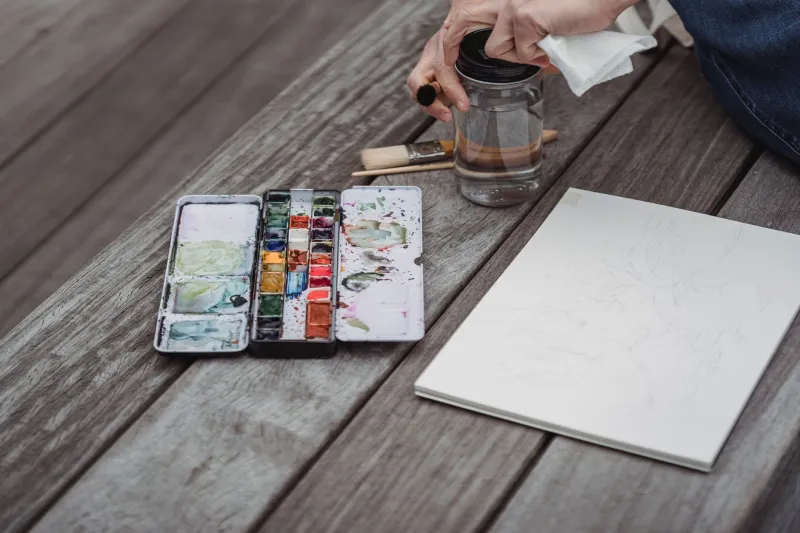
Think about a brand designer who picks up watercolor on the weekends. They're not painting to improve their logo work. But something happens anyway. The way pigment bleeds unpredictably into wet paper starts informing how they think about organic shapes and imperfect edges. The looseness they practice on Saturday morning shows up Monday in a brand system that feels alive instead of sterile.
Or consider an illustrator who gets obsessed with street photography. They're not drawing anything. They're just walking around their city with a phone or a film camera, hunting for interesting light and geometry. But every time they frame a shot, they're training their eye for composition in a context completely removed from their usual workspace. That training doesn't stay in the photography folder. It migrates.
This is cross-pollination in action. Different disciplines share underlying principles — rhythm, contrast, balance, tension, negative space — but they express those principles through entirely different physical and conceptual languages. When you spend time in one language, you come back to another with fresh translations.
Why "Just Work Harder" Is Bad Advice
There's a stubborn myth in creative culture that the answer to a block is always more effort. Push through. Stay at the desk. Grind until something gives. And sure, sometimes sheer persistence is what a project needs. But for the specific problem of generative thinking — coming up with something genuinely new — effort alone is often counterproductive.
Forcing creative output when your task-positive network is exhausted is a little like trying to remember a word by repeating the wrong word louder. The more you push, the more entrenched the wrong answer gets. Stepping away — especially into a different kind of making — actually clears the path.
Some of the most celebrated creative minds in American culture have operated this way intuitively. Designers who are also musicians. Architects who paint. Animators who sculpt. It's rarely framed as a productivity strategy, but that's exactly what it functions as.
Building Productive Accidents Into Your Routine
The good news is you don't need to become a Renaissance person overnight. You just need to introduce enough variety into your creative life that your brain has raw material to work with. A few things that actually help:
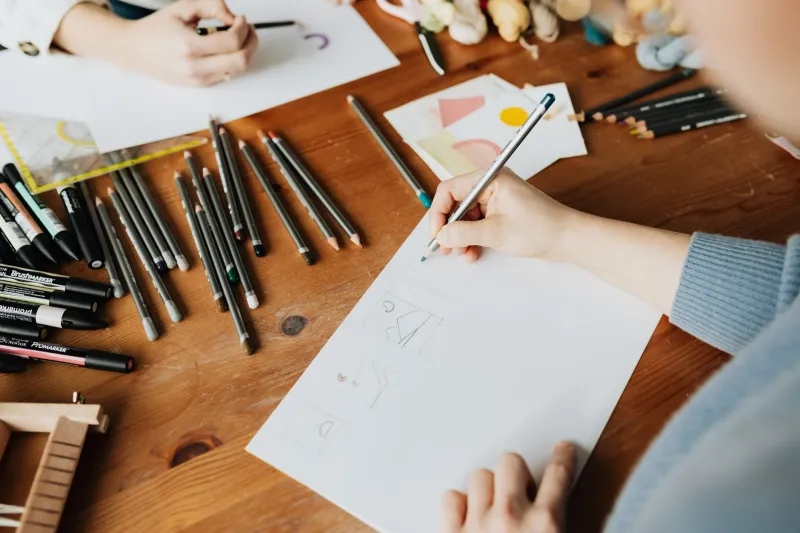
Keep a low-pressure side practice. It doesn't need to be good. It doesn't need to go anywhere. A sketchbook you never show anyone, a cheap point-and-shoot camera, a set of colored pencils that lives in your bag — the bar is just doing it, not producing anything worth sharing.
Let the two worlds stay separate. Resist the urge to immediately connect your side practice to your main work. The translation happens on its own, usually when you're not looking for it. Forcing the connection too early can actually short-circuit the process.
Notice when the crossover happens. Start paying attention to the moments when something from your off-hours making shows up in your professional work. Not to manufacture more of those moments artificially, but to start trusting the pattern. The more you notice it, the more you'll lean into the conditions that create it.
Vary the physical dimension. If your primary work is digital, your side practice should involve your hands in a literal, physical way. Ceramics, printmaking, woodworking, collage — anything that gives you resistance and texture and the satisfying weight of actual materials. The contrast between screen-based work and physical making seems to be especially productive for the incubation effect.
The Playground Principle
There's a reason this site is called Figure Playground. Play isn't the opposite of serious creative work — it's the engine underneath it. When you give yourself permission to make things without stakes, without deliverables, without an audience, you're not wasting time. You're filling the tank.
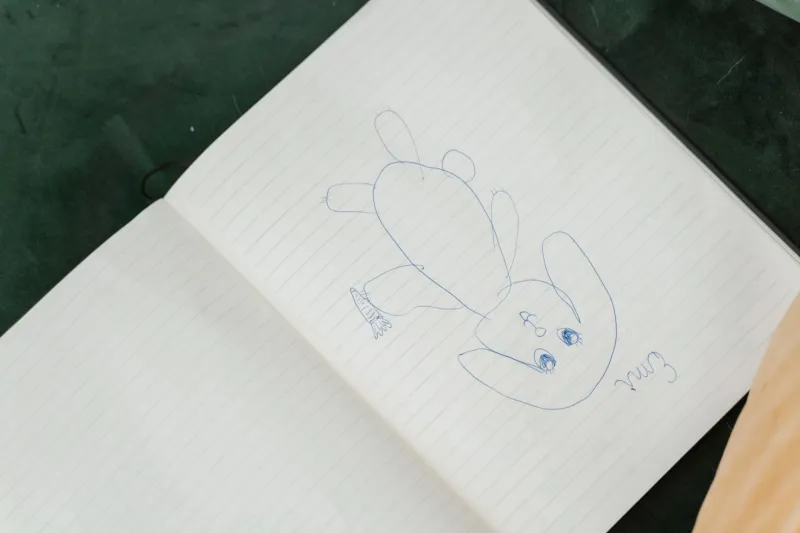
The restless hand that can't stop doodling during a phone call? That's not a bad habit. That's your creative brain refusing to go fully offline, quietly doing maintenance work while your conscious mind handles something else. Give it something interesting to play with, and it'll give you something worth building.