The Magic Happens When Nobody's Watching: How Hidden Creative Spaces Unlock Your Best Work
Open Instagram right now and you'll see a parade of perfectly composed flat lays, immaculate sketchbook spreads, and studio setups that look like they were designed by a set decorator. Everything is intentional. Everything is for someone. And honestly? A lot of it is genuinely impressive.
But here's the thing nobody's posting about: the crumpled napkin sketch from a Tuesday morning. The voice memo recorded in a parking garage that rambles for four minutes and somehow contains the seed of the best idea you've had all year. The chaotic desktop folder labeled "misc stuff DO NOT DELETE" that's been accumulating for three years and is somehow the most honest record of how your brain actually works.
Those invisible spaces? They're where the real thinking lives.
Why Your Brain Loosens Up in Private
There's a well-documented psychological phenomenon called evaluation apprehension — basically, the way performance anxiety creeps in the moment you sense you're being observed or judged. It doesn't take a formal audience. The mere act of opening a new document in your portfolio software, or starting a sketchbook you intend to share, can be enough to flip the switch from exploration mode to performance mode.
In performance mode, your brain is running a constant background process: Is this good enough? Will people get it? Does this look like I know what I'm doing? That's useful energy sometimes. But it's absolutely terrible for generating raw, unfiltered ideas.
Private creative spaces short-circuit that process. When something is genuinely not meant to be seen — when you know it's just for you — your brain stops auditing itself in real time. You start making weirder connections. You follow half-formed thoughts further than you normally would. You let ideas be ugly, incomplete, or flat-out wrong without immediately scrapping them.
That's not a bug. That's the whole point.
The Many Forms of the Invisible Studio
When most people think "private creative space," they picture a sketchbook. And yeah, sketchbooks are incredible for this — especially the cheap, unassuming ones with no pressure attached. But the invisible studio takes a lot of forms, and it's worth thinking about which ones fit how your brain naturally works.
Voice memos are massively underrated. Talking through an idea out loud — even just rambling — activates a different kind of thinking than writing or drawing. You can capture it mid-drive, mid-walk, mid-shower. The unpolished, conversational quality is a feature, not a flaw. Go back and listen to a voice memo you recorded six months ago. You'll often find something genuinely surprising.
Messy digital folders serve a similar function. Designers especially tend to have these — working files, abandoned concepts, screenshots of things that felt interesting for reasons you couldn't articulate yet. Treating these folders as a legitimate creative archive rather than digital clutter changes how you relate to them. They're not a mess to be cleaned up. They're a record of your subconscious at work.
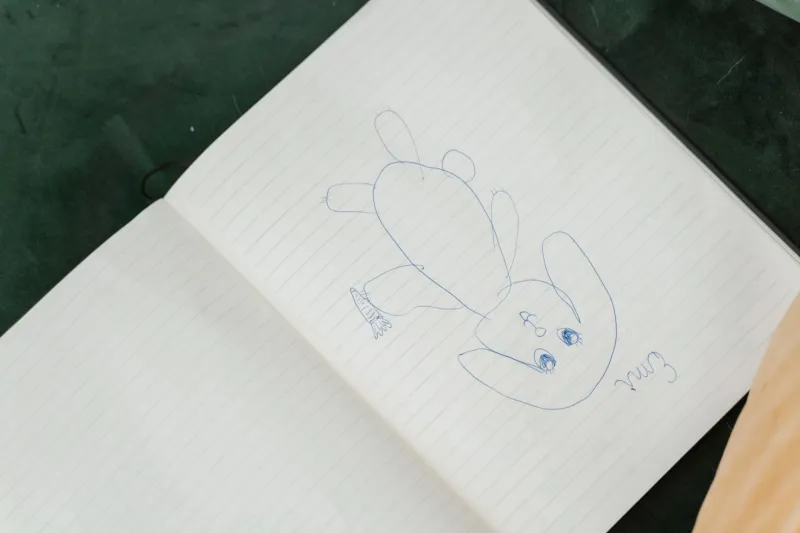
Low-stakes notebooks — not the beautiful $40 Leuchtturm1917 you're afraid to mess up, but the $3 composition notebook from Target — create permission to be bad. The cheapness is the point. When the object itself signals this doesn't matter, you're free.
Private playlists, mood boards, and reference dumps that you never intend to share also count. The act of collecting without curation is its own kind of creative practice. You're training your eye and building a private visual vocabulary that eventually surfaces in your public work in ways you can't always trace directly.
The Feedback Loop Between Private and Public
Here's where this gets strategically interesting: your invisible creative practice isn't separate from your public work. It's the engine that runs it.
Think of it like a river system. The big, visible river — your portfolio, your client work, your finished pieces — is fed by dozens of smaller tributaries. Most of those tributaries are hidden. They run underground, through private notebooks and voice memos and chaotic folders. But cut them off and the main river slows to a trickle.
A lot of creative blocks aren't actually blocks in the traditional sense. They're the result of trying to do all your thinking in public. When every mark you make is potentially shareable, you stop making the exploratory marks that lead somewhere interesting. The solution isn't to push harder on your public work — it's to rebuild the private pipeline.
Practically, this might look like committing to a morning pages practice that you will never, ever share. Or keeping a sketchbook that lives in a drawer rather than on a shelf. Or starting a private Pinterest board with zero followers where you pin things purely because they make you feel something, without needing to explain why.
Protecting the Private Space
One of the trickiest things about building an invisible creative practice in 2025 is the constant pull toward visibility. The platforms reward sharing. The algorithm wants content. Even well-meaning creative communities can create subtle pressure to document your process, share your sketchbook, post your works-in-progress.
There's nothing wrong with any of that — until it colonizes the private space entirely.
Guarding some portion of your creative life from public consumption isn't antisocial or secretive. It's actually a form of creative sustainability. The things you make only for yourself develop differently than the things you make for an audience. They're allowed to be stranger, more personal, more genuinely exploratory. And that strangeness is exactly what keeps your public work from going stale.
Try this: the next time you feel the impulse to photograph your sketchbook page and post it, pause. Ask yourself whether sharing it changes how you're using that space. Sometimes the answer is no, and sharing is totally fine. But sometimes you'll notice a subtle shift — a slight tightening, a move toward legibility over honesty. That's the signal to keep it private.
Give Your Ideas Room to Breathe
The best creative work almost always has a long, invisible prehistory. The finished illustration, the polished brand identity, the killer concept — these things don't spring fully formed from a single inspired moment. They're the result of a lot of private thinking that happened in spaces nobody ever saw.
Your scratchpad, in whatever form it takes, is where that thinking lives. Treat it like the serious creative infrastructure it actually is. Fill it without editing. Return to it without embarrassment. Let it be the place where your brain gets to be weird and wrong and exploratory — because that's exactly what feeds everything else.
The playground, after all, is where you figure out what you're actually capable of. Not every playground needs an audience.