Less Stuff, More Magic: The Creative Power of Working With Almost Nothing

Photo: Unknown runway photographer, CC BY-SA 4.0, via Wikimedia Commons
Here's a scenario that probably feels familiar. You sit down to start a new project with a blank canvas, every font in your library loaded up, a full 16-million-color picker at your fingertips, and access to every plugin and tool you've collected over the years. And then... nothing. You stare at the screen. You open a new tab. You check your phone. An hour passes.
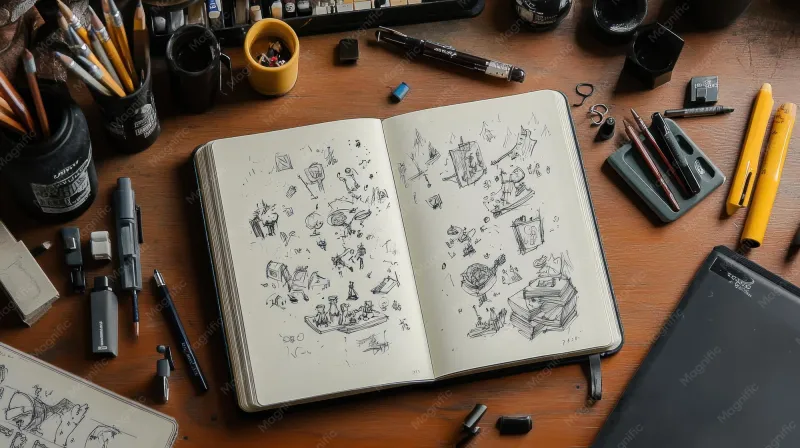
Now imagine someone hands you a single Sharpie and tells you to make something beautiful on a napkin. Suddenly, you're drawing.
This isn't a coincidence. It's actually one of the most well-documented phenomena in creative psychology, and once you understand it, it changes how you work forever.
The Paradox Nobody Talks About at Design School
We're conditioned to believe that more resources equal more potential. More colors means richer visuals. More typefaces means more expressive layouts. More software means more capability. But creative professionals who've been grinding for years often tell a different story — their most celebrated work happened under pressure, with limited tools, on a deadline, or inside a box someone else built.
Design theorist Barry Schwartz called a related idea the "paradox of choice" — the notion that too many options actually paralyze decision-making rather than empowering it. When you have everything available, you spend cognitive energy managing possibilities instead of making things. Constraints eliminate that overhead entirely. They force a decision by removing the option to keep deciding.
Think about it this way: a chess grandmaster doesn't complain that the game only has six types of pieces. The limitation is the game. The constraint is what makes mastery possible.
What Real Designers Are Actually Doing
Brooklyn-based graphic designer Maya Okonkwo (whose work you've probably seen on indie album covers and small-batch packaging) made a rule for herself two years ago: every personal project gets exactly two typefaces and three colors. That's it. No exceptions.
"At first it felt like punishment," she told us. "But then something weird happened. I stopped agonizing over font pairings and started focusing on composition, on rhythm, on what the work was actually trying to say. My work got sharper. Clients started noticing."
This tracks with how some of the most iconic visual identities in American design were built. Think about how much mileage certain brands have squeezed out of a single sans-serif and two colors for decades. The constraint isn't a limitation on the brand — it becomes the brand.
Illustrators have their own version of this story. Chicago-based artist and muralist Derek Salinas runs what he calls "single-tool Sundays" — one afternoon a week where he creates using only one instrument. Some weeks it's a ballpoint pen. Some weeks it's a single brush with one ink. The results, he says, are consistently the work he's proudest of.
"When you can't lean on variety, you have to get really good at the one thing in your hand," Derek explains. "You learn the tool at a molecular level. You find moves you never would have found otherwise."
The Neuroscience Bit (We'll Keep It Short, Promise)
There's actual brain science behind this. When faced with open-ended creative tasks, our prefrontal cortex — the part responsible for planning and decision-making — can become overloaded. Constraints act as a scaffold that offloads some of that cognitive weight, freeing up mental bandwidth for actual creative generation.
Researchers at Johns Hopkins found that jazz musicians showed decreased activity in the prefrontal cortex during improvisation compared to playing scales — suggesting that creative flow involves a kind of deliberate mental narrowing, not expansion. Constraints can artificially create that same narrowing.
In other words: your brain loves a fence. Not because it wants to be trapped, but because a fence tells it where the yard ends and where the playing field begins.
How to Build Your Own Creative Cage (The Good Kind)
Ready to try this yourself? Here are a few frameworks that actually work:
The Palette Prison Choose three colors before you start — one dominant, one accent, one neutral. Commit to them for the entire project. No swapping, no "just this once" exceptions. You'll be shocked how creative the problem-solving gets when you can't just grab a new color to solve a visual problem.
The One-App Challenge Pick a single piece of software and refuse to open anything else for a project. No jumping between Illustrator, Photoshop, Figma, and Procreate. One tool, start to finish. You'll discover capabilities in that tool you've been ignoring because you always outsourced that part of the work.
The Time Box Give yourself 25 minutes to produce a complete draft of something. Not a perfect thing — a complete thing. The artificial deadline eliminates the luxury of overthinking and forces commitment to ideas you'd normally second-guess into oblivion.
The Format Lock Decide upfront that everything in a series will be the same dimensions, the same orientation, the same aspect ratio. No flexibility. Watch how your compositions evolve and grow more inventive over the course of the series as you exhaust the obvious solutions.
When Constraints Become Crutches
Fair warning: there's a flip side. Constraints work best when they're intentional and temporary. If you find yourself using "I only work in two colors" as a reason to avoid learning new techniques or challenging your range, that's not liberation — that's comfort disguised as discipline.
The goal is to use constraints as a launchpad, not a permanent home. Run a constrained project, see what it teaches you, then carry those lessons into your next unconstrained work. You might find you naturally make tighter decisions even when you have full freedom, because you've trained your creative instincts to cut through the noise.
Play Is the Point
At Figure Playground, we believe creativity is fundamentally about play — and play, if you think about it, has always required rules. You can't play tag without the rule that you have to run. You can't play basketball without the rule that the ball has to go through the hoop. The rules don't ruin the game. They create it.
Your next project doesn't need more options. It might just need a smaller sandbox. Try it once — really commit to it — and see what you make when making is the only option left.