Turn Your Feed Into a Fuel Source: A Creative Person's Guide to Social Media That Actually Works For You
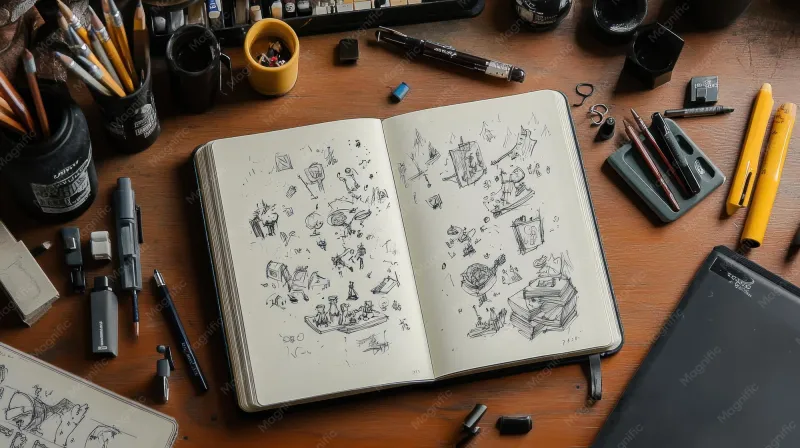
Photo: artist or illustrator using phone for inspiration with sketchbook open on desk, via img.freepik.com
Let's be honest about something. You opened Instagram to get inspired. Forty-five minutes later you've seen seventeen artists who are more talented than you, three viral trends you feel vaguely obligated to participate in, two brand deals that made you question your career, and one Reel that was genuinely funny but you can't remember what it was about. You close the app feeling worse than when you opened it.
Sound familiar? You're not broken, and you're definitely not alone. For creative professionals — illustrators, graphic designers, muralists, animators, photographers — social media is simultaneously the best and worst thing that ever happened to the industry. It's a global portfolio, a client pipeline, a community hub, and a creativity black hole, all in one app.
The good news: it doesn't have to be this way. A growing number of working artists have figured out how to use social media as a genuine creative resource rather than a passive drain. Here's what they know that most of us don't.
Why Your Brain Feels Like Mush After Scrolling
First, let's talk about what's actually happening when you doomscroll. Social media algorithms are engineered — brilliantly, ruthlessly engineered — to maximize time on platform. They do this by triggering a dopamine loop: variable reward, unpredictable content, occasional hits of genuine delight or outrage. It's the same mechanism that makes slot machines so effective.
For creative people, this is especially dangerous. Our work requires what psychologists call "divergent thinking" — the ability to make unexpected connections, explore multiple possibilities, and sit comfortably with ambiguity. Passive scrolling does the opposite. It puts you in a reactive, consuming state that's almost the neurological inverse of creative flow.
Illustrator and surface pattern designer Priya Mehta, based in Austin, Texas, describes it this way: "After a long scroll session, I feel like I've eaten an entire bag of chips. Full but somehow still hungry, and a little gross. My sketchbook just sits there."
The problem isn't social media itself. It's the mode in which most of us use it.
Passive Consumption vs. Active Curation — Know the Difference
There are two completely different ways to exist on social media, and most people never consciously choose between them.
Passive consumption is what the algorithm wants. You open the app, it shows you what it's decided you should see, and you react. You're a passenger.
Active curation is something else entirely. You decide what's in your feed. You seek out specific accounts, deliberately unfollow others, use lists and collections intentionally, and treat the platform as a tool rather than an environment you wander through.
The shift sounds simple, but it requires ongoing effort because the algorithm is constantly trying to pull you back into passenger mode. Every time you linger on a video that's slightly outside your intentional feed, the platform learns and nudges. You have to keep steering.
Building a Feed That Actually Inspires You
San Francisco-based graphic designer and lettering artist James Tran did a full social media audit last year — something he now recommends to every creative he mentors. Here's a version of his process:
The Honest Unfollow Go through every account you follow and ask one question: does this account make me want to make something, or does it make me want to stop making something? Accounts that trigger comparison, envy, or imposter syndrome — no matter how technically impressive — might need to go. This isn't about being petty. It's about protecting your creative headspace.
The Reference Folder Instead of just scrolling past work you love, save it. Build organized collections by theme, color, technique, or mood. Instagram, Pinterest, and TikTok all have save features that most people underuse. When you sit down to work and need a jump-start, you have a curated library of things that you found genuinely exciting — not whatever the algorithm decided to serve up that morning.
The Follow-Up When you discover an artist or designer whose work genuinely moves you, don't just follow them. Go deeper. Visit their website. Read their interviews. Watch their process videos. The algorithm-friendly surface of a social feed rarely shows you the full depth of a creator's thinking. The interesting stuff is usually one click further.
The Scheduled Scroll Rather than picking up your phone whenever you have a spare moment, try designating specific windows for social media browsing — say, 20 minutes in the morning and 20 minutes in the evening. Outside those windows, the apps stay closed. This sounds rigid, but it transforms scrolling from a reflex into a deliberate activity, which completely changes how your brain processes what it sees.
Seek Out the Weird Corners of the Internet
Here's something working artists consistently mention: the most genuinely inspiring content rarely comes from the most popular accounts. The big accounts post what performs. The smaller, weirder accounts post what they're obsessed with.
Priya Mehta's best recent inspiration came from a 2,000-follower account posting close-up photos of vintage linoleum patterns. James Tran keeps a list of accounts run by museum archivists, textile conservators, and type historians — people who post because they're genuinely fascinated by something, not because they're building a brand.
Algorithms tend to flatten things toward the popular and the proven. Actively seeking out niche, under-the-radar accounts is a way to find material that hasn't already been processed and reposted a thousand times. Your brain responds differently to something it hasn't seen everywhere already.
Create More Than You Consume
This one sounds obvious but bears repeating: the ratio matters. If you're spending three hours consuming creative work for every one hour making it, the math isn't working in your favor.
Several designers we spoke to use a simple rule: they don't open social media until they've already done some creative work that day. Even just 15 minutes of sketching, doodling, or writing ideas in a notebook. This keeps the creative muscle warm and ensures that when you do go online, you're entering from a position of making rather than a position of lack.
Your Feed Is a Creative Environment — Treat It Like One
At Figure Playground, we think a lot about the environments that creativity lives in. Physical studios, sketchbooks, the particular light of a specific time of day — these things matter. Your social media feed is also a creative environment, and most people furnish it by accident.
You wouldn't fill your studio with work that made you feel bad about yourself. You wouldn't hang reference images that bored you. Apply the same intentionality to the digital space where you spend a significant chunk of your mental life.
Curate aggressively. Protect your attention. And remember: the goal isn't to stop scrolling — it's to scroll like someone who makes things.