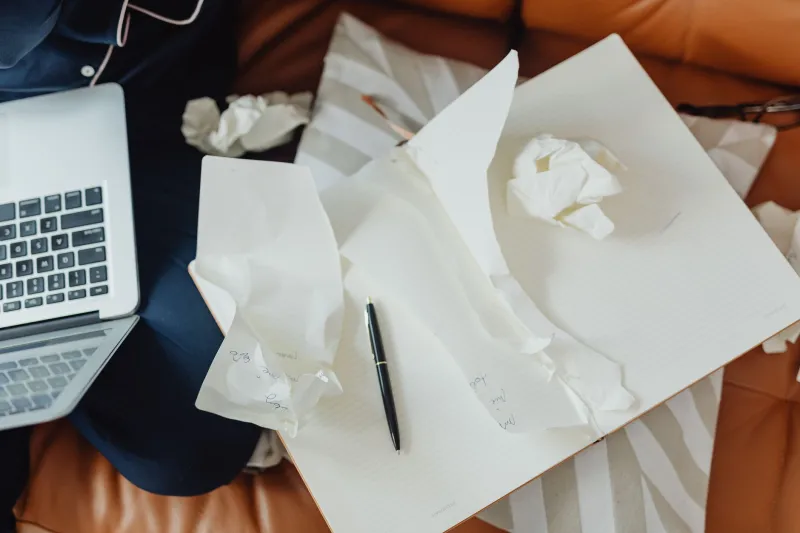
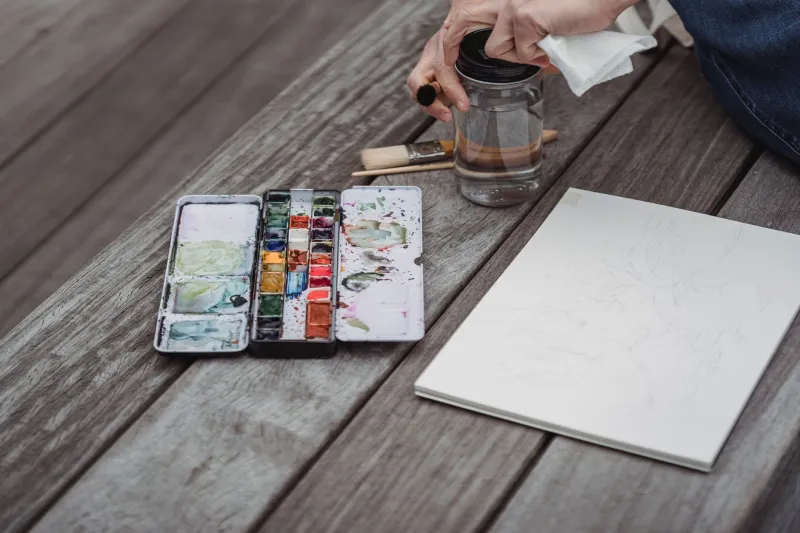
Spilled, Glitched, and Gloriously Wrong: How Accidents Became the Best Move You Never Planned
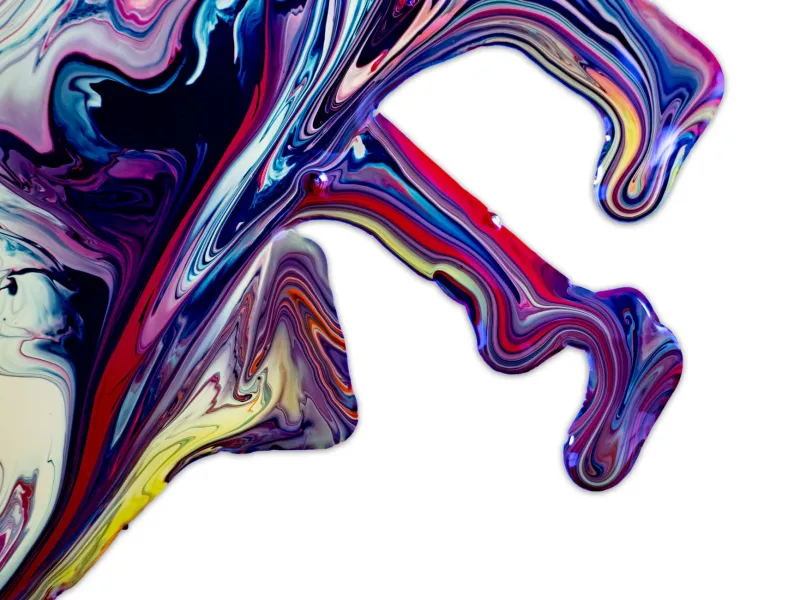
Here's something nobody tells you in art school: the moment you stop controlling everything is often the moment your work gets interesting.
We're not talking about laziness or sloppiness. We're talking about those electric, unplanned moments — when your brush drops mid-stroke, when Photoshop does something deeply weird to your layers, when you grab the wrong tube of paint and suddenly the whole piece shifts. These aren't failures. They're invitations.
The creative world has a long, beautiful history of people who tripped and fell into their own genius. And the wild thing? Once you understand why accidents work so well, you can start building conditions where they happen more often.
Your Brain Is Bored of Your Plan
Here's the psychology behind the happy accident: when you're executing a predetermined idea, your brain is essentially running a script. It's checking boxes. Staying on track. The prefrontal cortex — your inner project manager — is very much in charge.
But when something unexpected happens? That script gets interrupted. Your brain has to improvise, and that activates a different mode of thinking — one that's more associative, more flexible, more willing to connect dots that don't obviously belong together.
Researchers who study creative cognition call this a shift from convergent thinking (narrowing toward a known answer) to divergent thinking (opening up to multiple possibilities). Accidents force divergence. They kick the project manager out of the driver's seat and let the weirder, more intuitive part of your brain take over for a minute.
That's where signatures get born.
The Drop, the Spill, the Corrupt File
Talk to almost any working designer or illustrator long enough, and they'll have a story. A moment where something went sideways and they thought, wait — what if I just... kept going with this?
Take the texture obsession that defines a lot of contemporary print-inspired digital design right now. A huge chunk of it traces back to designers who accidentally applied grain or noise filters at the wrong stage of a project and liked how it roughed up the clean edges. What started as a mistake became an aesthetic movement.
Or think about the whole genre of glitch art — distorted imagery, corrupted color fields, fragmented type. That entire visual language came from artists who looked at broken files and saw beauty instead of a tech support ticket.
The common thread? They didn't immediately hit undo.
Why "Undo" Is Sometimes the Wrong Move
We live in a Ctrl+Z culture. Every digital tool we use makes it effortless to erase the unintended. And honestly, that's mostly great — but it also trains us to treat accidents as automatic problems rather than potential discoveries.
The next time something unexpected happens in your work, try giving yourself a ten-second rule before you reach for undo. Just look at it. Ask: Is there anything here I actually want? Not "is this what I planned" — but "is there something worth keeping?"
You don't have to use it. But you have to look first.
This tiny habit shift can genuinely change how you work. You start developing an eye for what accidents are telling you about your own instincts — which textures you're drawn to, which color collisions feel alive, which compositional chaos has a kind of accidental logic to it.
Building a Playground for Productive Chaos
Here's where it gets fun. Once you understand that accidents are generative, you can start engineering situations where they're more likely to happen. Think of it as setting the stage for serendipity.
Try the constraint swap. Pick up a tool that isn't your go-to and use it for something it wasn't designed for. Use a wide house-painting brush for detail work. Use a technical pen for loose, gestural marks. The mismatch between tool and intention creates friction — and friction creates surprises.
Work faster than you're comfortable with. Speed disrupts precision. Set a timer for five minutes and make something finished — or at least done — before it goes off. The rushed decisions you make under that pressure often reveal preferences you didn't know you had.
Change the surface. If you always work on the same paper, the same canvas, the same artboard dimensions — switch it. Drastically. Work on a weird aspect ratio. Work on something textured when you usually go smooth. The surface talks back, and it'll say things you didn't expect.
Let your software misbehave. Next time you're in a digital tool, try dragging sliders past their "intended" range, stacking effects in an order that doesn't make logical sense, or applying a filter to a layer type it wasn't meant for. Save your file before you do it, obviously — but then go break something on purpose and see what happens.
Keep an accident archive. This one's huge. Start saving the weird outtakes, the botched experiments, the files you almost deleted. Give them a folder. Look at them together after a few weeks. Patterns will emerge — and those patterns are your signature style trying to introduce itself.
The Difference Between an Accident and a Mistake
Not every accident is a keeper. Let's be real. Some spills are just spills. Some glitches are just annoying. The skill you're developing isn't about loving every unplanned outcome — it's about staying curious long enough to figure out which ones have something to say.
The designers and artists who've built the most distinctive visual voices tend to share one trait: they're genuinely curious about their own reactions. When something unexpected happens, they notice what they feel before they decide what to do. That split second of honest response — before the inner critic kicks in — is where the real information lives.
Is there a flicker of excitement? A weird pull toward the mistake? Follow that.
Is it just frustrating with nothing interesting underneath? Yeah, okay, hit undo. No shame.
You Already Have More Accidents Than You Think
Scroll back through your old work. Not your portfolio — your actual working files, your sketchbooks, the stuff you never showed anyone. Look for the moments where something unexpected crept in. Where a piece went somewhere you didn't intend.
Chances are, some of your favorite work lives in those moments. The pieces that feel most you are often the ones where you stopped executing a plan and started responding to what was actually in front of you.
That's not an accident. That's your style, showing up uninvited and making itself at home.
Let it stay.