That Terrible Idea You Threw in the Trash? Go Dig It Back Out.
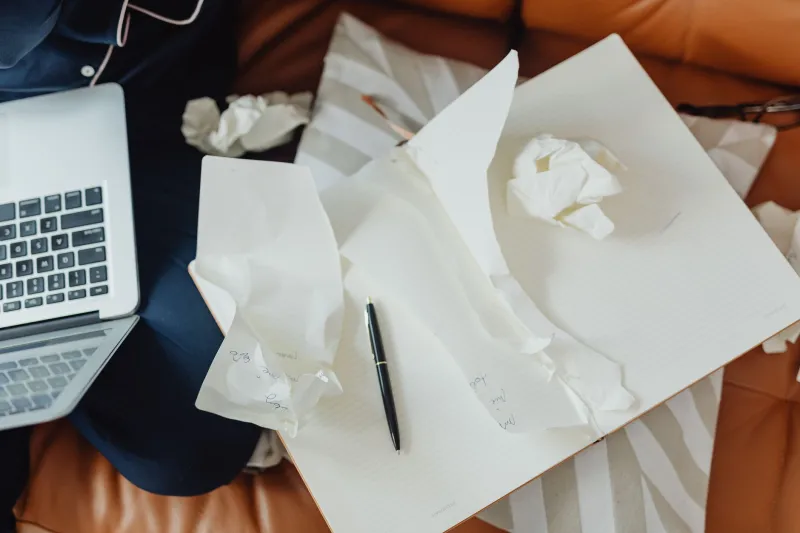
You know that moment when an idea lands in your brain and you immediately go nope? You close the sketchbook. You delete the file. You maybe even feel a little embarrassed that your own mind went there. And then, two weeks later, you're staring at a blank canvas wondering why nothing is working.
Here's the thing nobody tells you early enough in your creative life: that idea you rejected might not have been wrong. It might have just been early.
Why We're So Quick to Kill Our Own Ideas
There's a psychological concept called premature closure — the tendency to settle on a judgment before we've fully explored the territory. In creative work, it shows up constantly. We evaluate ideas almost the instant they appear, running them through a filter built from past criticism, client feedback, trend awareness, and a whole lot of self-doubt. Most ideas don't survive that gauntlet.
But that filter, useful as it is, has a blind spot. It's optimized for what has worked before. It's terrible at recognizing what might work in a context that doesn't exist yet.
San Francisco-based illustrator Dana Reyes puts it bluntly: "I used to keep a 'no' folder — literally a folder on my desktop where I'd dump everything I thought was garbage. I started going back through it when I got stuck, and I cannot tell you how many times something I'd written off became the seed of a project I was actually proud of. The ideas weren't bad. I just wasn't ready for them yet."
The Brain Needs to Take the Wrong Road First
Neuroscience has something to say about this, and it's genuinely interesting. When we're problem-solving, our brains don't work in straight lines — they explore possibility space through a kind of associative sprawl. Dead ends aren't wasted effort. They're the process. Each rejected path actually narrows the search space and primes the brain to recognize something better when it shows up.
This is partly why creative breakthroughs so often happen after a period of frustration rather than before it. The ugly, unproductive phase isn't a detour around the good work — it's the setup for it.
Chicago-based brand designer Marcus Tillman describes his process as "composting." "I let bad ideas sit," he says. "They break down. And whatever's left after that — the part that didn't rot — that's usually something real. Something I can actually build with."
What Makes a 'Failed' Idea Actually Useful
Not every discarded concept is secretly a gem. But there's a specific type of rejected idea worth revisiting: the one that made you uncomfortable for reasons you couldn't fully articulate.
If an idea felt too weird, too risky, too different from what you normally do — that discomfort is worth examining. It often signals that the concept was pushing against a genuine creative boundary, not just being objectively bad.
On the other hand, ideas that felt flat or derivative? Those you can probably leave in the trash.
The trick is learning to tell the difference. A few questions worth asking when you revisit something you dismissed:
- Why did I reject this, exactly? Was it a craft problem (execution was off) or a concept problem (the idea itself didn't hold up)? Craft problems are often fixable. Concept problems are trickier.
- What was I afraid of? Fear-based rejection is usually worth interrogating. Boredom-based rejection is a cleaner signal to move on.
- Does this still make me feel something? Even cringe is a feeling. Apathy is the real dead end.
Practical Ways to Mine Your Rejects
So how do you actually build a practice around this? A few approaches that working creatives swear by:
Keep a dedicated archive. This sounds simple, but most people don't do it. Instead of deleting early drafts or old sketchbook pages, keep them somewhere accessible. Even a messy folder on your desktop works. The goal is to make revisiting easy — if retrieval requires effort, you won't do it.
Set a 30-day rule. Don't evaluate an idea's worth until at least 30 days after you first had it. First impressions in creative work are notoriously unreliable. Time creates distance, and distance creates clarity.
Remix rather than resurrect. The goal isn't to revive a failed idea wholesale — it's to extract something from it. Take one element: a color relationship, a structural decision, a weird visual metaphor. Strip everything else away and see if that fragment survives on its own.
Show your rejects to someone else. We're often the worst judges of our own discarded work because we remember why we rejected it. Another set of eyes doesn't carry that baggage. What looks like a dead end to you might look like a starting point to a collaborator.
The Reframe That Changes Everything
Here's the mental shift that makes all of this work: stop thinking of failed ideas as evidence of creative failure and start thinking of them as raw material.
Every creative discipline has this built into its vocabulary. Architects call early rejected schemes "parti explorations." Writers talk about "killing your darlings" with the implicit understanding that those darlings go somewhere — they don't just vanish. Sculptors literally chisel away what doesn't belong, and the chips on the floor aren't failures. They're how the form gets found.
Figure Playground exists precisely because creativity isn't a clean, linear thing — it's a messy, generative, shape-shifting process. The figures we build don't always look right the first time. Sometimes the most interesting shapes emerge from the ones we almost threw away.
Your worst idea might not be your worst idea. It might be your next one, waiting for you to catch up to it.
Go check the trash.