Stop Trying So Hard: The Science of Why Your Brain Solves Problems When You're Goofing Off
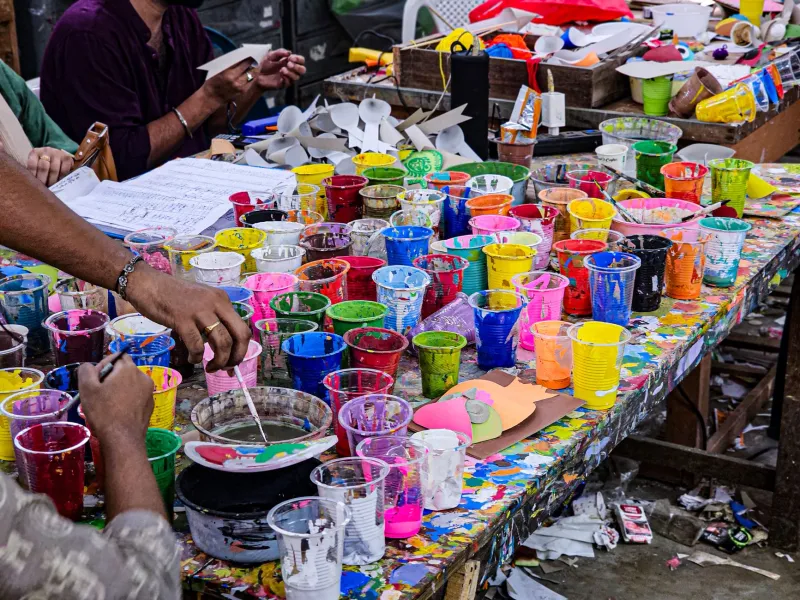
You know that feeling. You've been staring at a blank canvas, a half-finished layout, or a logo concept that refuses to click — for what feels like three business days. You step away to grab a coffee, zone out in the shower, or doodle something completely pointless in the margins of your notebook. And then, out of nowhere, there it is. The idea. The one that makes everything else fall into place.
That's not a coincidence. That's your brain doing exactly what it was built to do — and it happens precisely because you stopped forcing it.
Your Brain Has a Secret Mode (And It Kicks In When You're Not Paying Attention)
Neuroscientists call it the Default Mode Network, or DMN. It's a cluster of brain regions that lights up not when you're intensely focused, but when your mind is wandering — daydreaming, doodling, taking a walk, letting your thoughts drift. For a long time, researchers thought the DMN was just the brain idling. Turns out, it's one of the most creatively productive states your mind can enter.
When you're locked into task-focused concentration, your prefrontal cortex is running the show — logical, sequential, a little uptight. It's great for executing plans, but it's a terrible brainstorming partner. The DMN, on the other hand, is a connector. It pulls in loosely associated memories, half-formed impressions, and unexpected combinations from all over the place. That's where metaphors get born. That's where the weird-but-brilliant idea comes from.
Here's the kicker: you can't access the DMN on command. You can only create conditions that invite it in. And those conditions look a whole lot like play.
The Playground Wasn't Wasted Time
Think about what recess actually was. Nobody told you what to build, what game to invent, or what the rules were supposed to be. You just started doing something — anything — and figured it out as you went. The outcome didn't matter. Nobody graded your sandcastle. Nobody evaluated the quality of your made-up game. You were just in it, fully, without the pressure of producing something worth keeping.
That's the playground mindset. And somewhere between junior high and your first design brief, most of us lost it.
Professional creative culture has a complicated relationship with play. We love the idea of it — ping pong tables in studios, "creative brainstorm sessions," whiteboards covered in colorful sticky notes. But most of those environments still carry outcome pressure. There's a meeting at the end. There's a client waiting. There's a right answer hiding somewhere in all those Post-its, and everyone knows it.
True play doesn't have a right answer. That's what makes it work.
Structured Aimlessness: A Real Thing You Can Practice
Here's where it gets practical. You don't need to quit your job and move to a commune to reclaim the playground mindset. You just need to build small, intentional pockets of low-stakes creative experimentation into your regular workflow.
Call it structured aimlessness. The structure isn't about goals — it's about giving your brain a container to wander inside of without completely dissolving into a Netflix spiral.
Try the 15-Minute Junk Drawer Exercise. Set a timer. Grab whatever's within arm's reach — old magazines, a Sharpie, some masking tape, a takeout menu, whatever. Make something out of it. Not something good. Not something you'd show anyone. Just something. The rule is that it has to be done when the timer goes off, and you can't judge it until tomorrow. This exercise isn't about the output. It's about switching off the internal critic long enough for your DMN to stretch its legs.
Try Constraint Doodling. Pick one shape — a circle, a squiggle, a zigzag — and fill an entire page with variations of it. No plan. No composition goals. Just that shape, over and over, until your hand is bored and your brain starts going somewhere else. That "somewhere else" is the good stuff. Keep a separate piece of paper nearby to catch whatever floats up.
Try the Wrong Tool Swap. If you're a digital designer, sketch your next concept with a fat brush and watercolors. If you're a painter, try building your composition in a word processor using only text characters. Using the wrong tool for the job forces your brain out of its habitual grooves and into a more exploratory, playful mode — because you literally can't do it "right," so you stop trying to.
Why Brainstorming Sessions Often Miss the Point
Group brainstorming has its place, but the research on its effectiveness is... let's say, humbling. Studies going back to the 1950s have consistently found that people generate more and better ideas alone than in group brainstorms — largely because the social pressure of the room triggers evaluation anxiety. Even when facilitators explicitly say "no bad ideas," everyone in that conference room knows there are bad ideas. They've sat in enough meetings to know.
The playground mindset is essentially the opposite of a brainstorming session. It's private. It's low stakes. It's allowed to be dumb. It's allowed to go nowhere. And paradoxically, it's far more likely to produce something genuinely surprising.
This doesn't mean collaboration is bad — it means the timing of collaboration matters. Let people play alone first. Let ideas get weird and half-baked in private before they hit the fluorescent light of a group critique. You'll bring better material to the table, and you'll hold it more loosely because you didn't perform it into existence in front of an audience.
Making Play a Non-Negotiable Part of Your Practice
The designers, illustrators, and artists who seem to generate ideas effortlessly usually aren't working harder than everyone else. They've just built a sustainable relationship with their own creative process — one that includes regular, guilt-free time to mess around with no agenda.
That might look like keeping a sketchbook that nobody ever sees. It might look like spending Sunday mornings making collages out of junk mail. It might look like playing a video game specifically because it has nothing to do with your work. The content doesn't matter as much as the quality of attention — relaxed, curious, unattached to outcome.
Figure Playground exists because of exactly this idea. Creativity isn't a performance. It's a place you go. And the more you visit, without always needing to bring something back, the richer that place becomes.
So the next time someone asks why you're doodling nonsense during a slow afternoon, tell them you're working. Because honestly? You are.