The Playground Was the First UX Lab: A Photo Field Guide for Your Studio
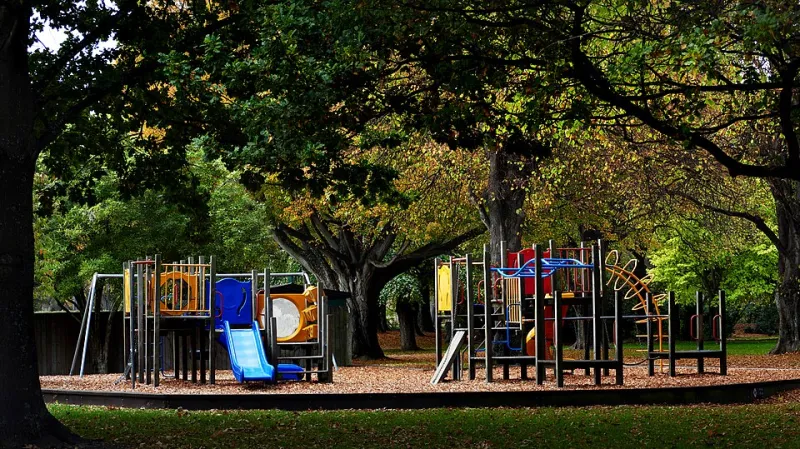
Photo: Bernard Spragg. NZ from Christchurch, New Zealand, CC0, via Wikimedia Commons
The next time you need design inspiration, skip the mood board and go to a playground. Not to swing. Not to supervise. Go with a camera and a notebook, preferably on a weekday morning when the place is quiet. Playgrounds solve the same problems creative studios do: they guide attention, invite exploration, and make room for happy accidents.
This is a photo field guide, not a nostalgia trip. Bring your phone or a small camera. Shoot structures, surfaces, paths, and edges. Avoid photographing kids faces. You are not making a documentary about childhood. You are making a visual case study about layout, movement, and play.
Shoot the Zones, Not the Swings
Every good playground has zones. There is a noisy zone with climbers and slides. There is a quieter zone with sand or seating. There is a transition zone where adults stand and kids decide what to do next. Photograph each zone as a wide shot, then take a detail shot of what makes it distinct.
Translate that to your studio. Do you have a loud zone for making mess and a quiet zone for thinking? Is there a transition area where projects can sit before they are filed or trashed? Most studios have one big zone and a lot of denial. A playground would never make that mistake.
Follow the Paths People Actually Take
Playground designers plan routes, but kids wear new ones into the grass. Look for desire lines: the dirt shortcuts, the flattened corners, the spot where everyone cuts behind the climbing wall. Photograph those worn paths. They are honest feedback.
Your studio has desire lines too. They are the route from the door to the desk, the path from the printer to the cutting mat, the spot where you always pile things because the shelf is too far away. Photograph your own workspace the same way. Do not shoot the idealized version. Shoot the worn route. Then move the tools to meet the path instead of fighting it.
Risk Is a Design Material
Playgrounds used to be smooth and safe and boring. Then designers remembered that a little risk is part of play. Not danger. Risk. A balance beam that is a few feet off the ground. A climber with more than one way up. A loose part that can become a shovel, a lever, or a hat.
In a studio, risk looks like visible materials, permission to make a mess, and a project that is allowed to fail in public. Photograph the playground elements that invite a controlled wobble. Then ask where your workspace invites a wobble. If everything is locked down, labeled, and impossible to rearrange, you have built a waiting room, not a creative space.
Surprise and the Art of Loitering
Good playgrounds have nooks. A tunnel. A hidden corner under a deck. A bench that faces the action but sits just outside it. These are loitering spaces, and they matter. They let kids watch before they join. They let adults breathe without leaving.
Your studio needs loitering spaces too. Not another task chair. A reading corner. A pinboard. A shelf of objects that do not have a project yet. Photograph the odd corners of the playground, the ones that are not part of the main circuit. Then build one at home. Surprise needs somewhere to land.
Flow: The Route From Entry to Exit
Take a series of photos that follow one path through the playground: entrance, first choice, main activity, side quest, exit. You will notice a rhythm. Arrival is open. The middle is dense. The end is soft. There is a sequence, but not a script.
Map that rhythm onto a work session. How do you enter a project? Where is the dense middle? What helps you leave it? If your studio only has a hard start and a hard stop, you are missing the soft edges. A playground knows that the best play often happens in the transition.
Bring the Photos Back to Your Desk
Print a contact sheet. Annotate it with arrows and circles. Mark the zones, the worn paths, the risky bits, the loitering spots, and the flow. Then make one small change to your studio this week. Move a tool. Clear a corner. Add a chair that is not for working. Put a weird object where you can see it.
The playground was never just for kids. It was a design lab with slides. Take the photos. Steal the principles. Leave the sand where it belongs.